


It’s a good time to start looking at what’s in store for the 2026-27 Chicago Blackhawks.
I have this broken down into four main parts: forwards, defensemen, goaltenders, and predictions. This is meant to be a general overview of the team. There are a lot of questions that could be further explored, but for the sake of brevity in an already somewhat lengthy article, I tried to keep it brief.
Let’s rip the band-aid off.
By The Numbers
Record: 29-39-14 (72 points)
Points Percentage: .439 (31st)
5v5 Corsi: 45.60% (30th)
Expected Goals Share (xG): 42.25% (32nd)
5v5 Save Percentage: .900 (23rd)
5v5 Shooting Percentage: 9.56% (17th)
5v5 PDO: .996 (20th)
Power Play: 16.9% (29th)
Penalty Kill: 83.6% (2nd)
The Forward Core
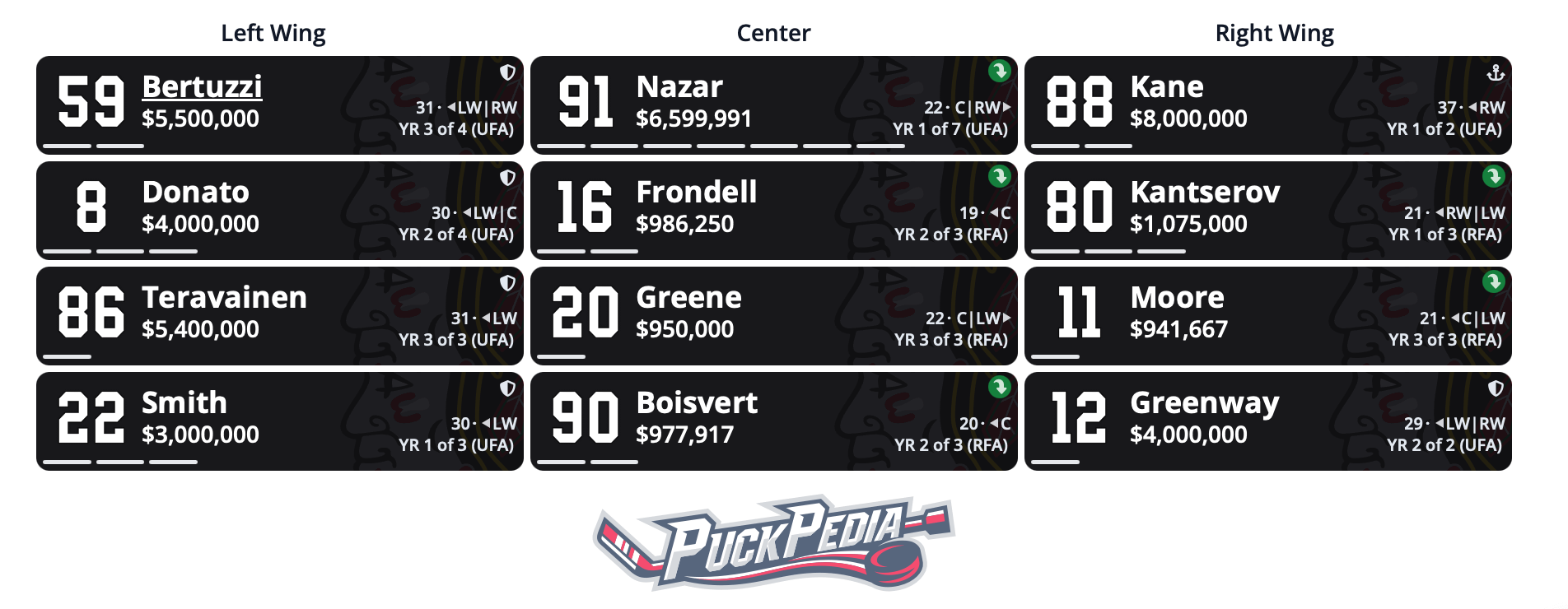
In: Patrick Kane, Roman Kantserov, Jordan Greenway, Cole Smith
Out1: Ilya Mikheyev (free agency), Andre Burakovsky (traded at the draft)
Scratched: Landon Slaggert, Andrew Mangiapane
Injured: Connor Bedard
Let’s kick off this very generalized look at the upcoming season with the forward core. And yes, we’ll get to Nick Lardis in a moment.
The Blackhawks biggest need over the summer (in my opinion) was acquiring a winger for Connor Bedard.
Before Connor Bedard was injured, Davidson seemed pretty content with what he had in his forward core—and very confident in Roman Kantserov, too. Kantserov (36 G and 64 P in 63 games in the KHL) was slotted in as the winger who met that need for Bedard. Even though his numbers are impressive (ninth overall in scoring in the KHL last season), we still don’t know how Kantserov will adjust to the NHL. He’s still only 21 years old. A more sure-fire approach would have been finding an established NHL player.
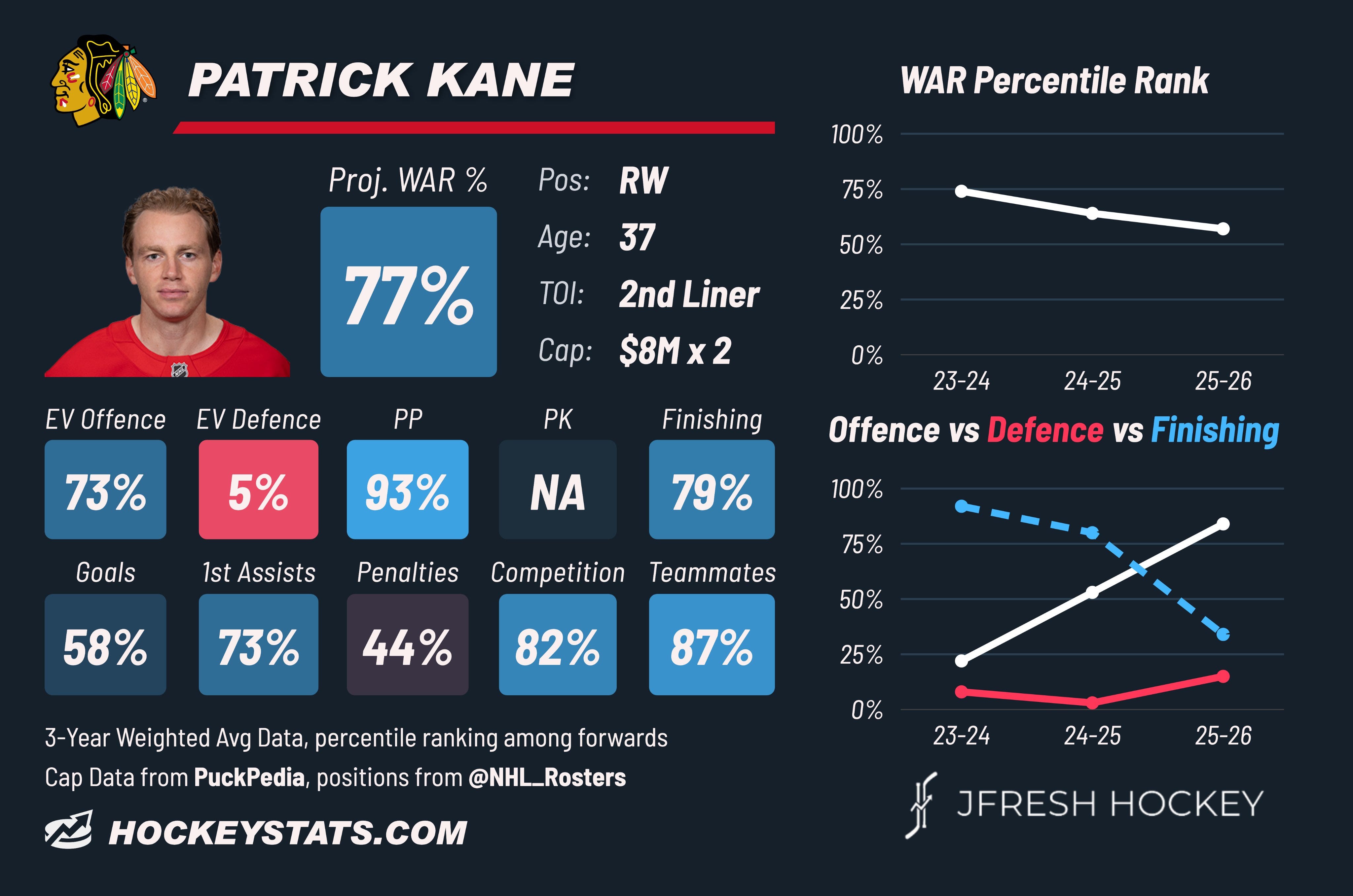
It wasn’t until Bedard’s injury sidelined him until November that the rumors of a potential Patrick Kane return seemed like an actual possibility. At 37 years old, Kane put up 57 points in 67 games last season with the Detroit Red Wings. While there’s speculation over whether this was just a “nostalgia move” to hold over fans until Bedard returns, the real questions surround his impact on this roster. How much will Kane help the forwards out? And when Bedard returns, how well will those two play together, if on the same line all?
And it’s the young forwards on this Hawks team that will be the most interesting to watch this season.
The screenshot at the top of this article shows the current lineup on PuckPedia. If I played around in their GM mode, I might add Nick Lardis to the top-six. He only scored 15 points in his 41 games last season, but it’s how he played a smart game that makes me optimistic that Lardis could be a top-six winger.
Frank Nazar will start the season in a 1C role. Through 66 games he scored 41 points, but that came with a very quiet middle of the season. If Nazar looks really good to start the season, well, that’s how he started last season. Take it with a grain of salt. He scored 11 points in his first 10 games, then scored a meager 10 points in 34 games. For Nazar it will be about maintaining consistent scoring throughout the entire season.
Anton Frondell looked like the real deal in his 12 games last season. Ryan Greene made a strong case for a bottom six forward (could he even be a middle six forward?). Oliver Moore, while fast and intriguing, will need to establish his future role. Is he a center or on the wing?
Then there’s the stats.
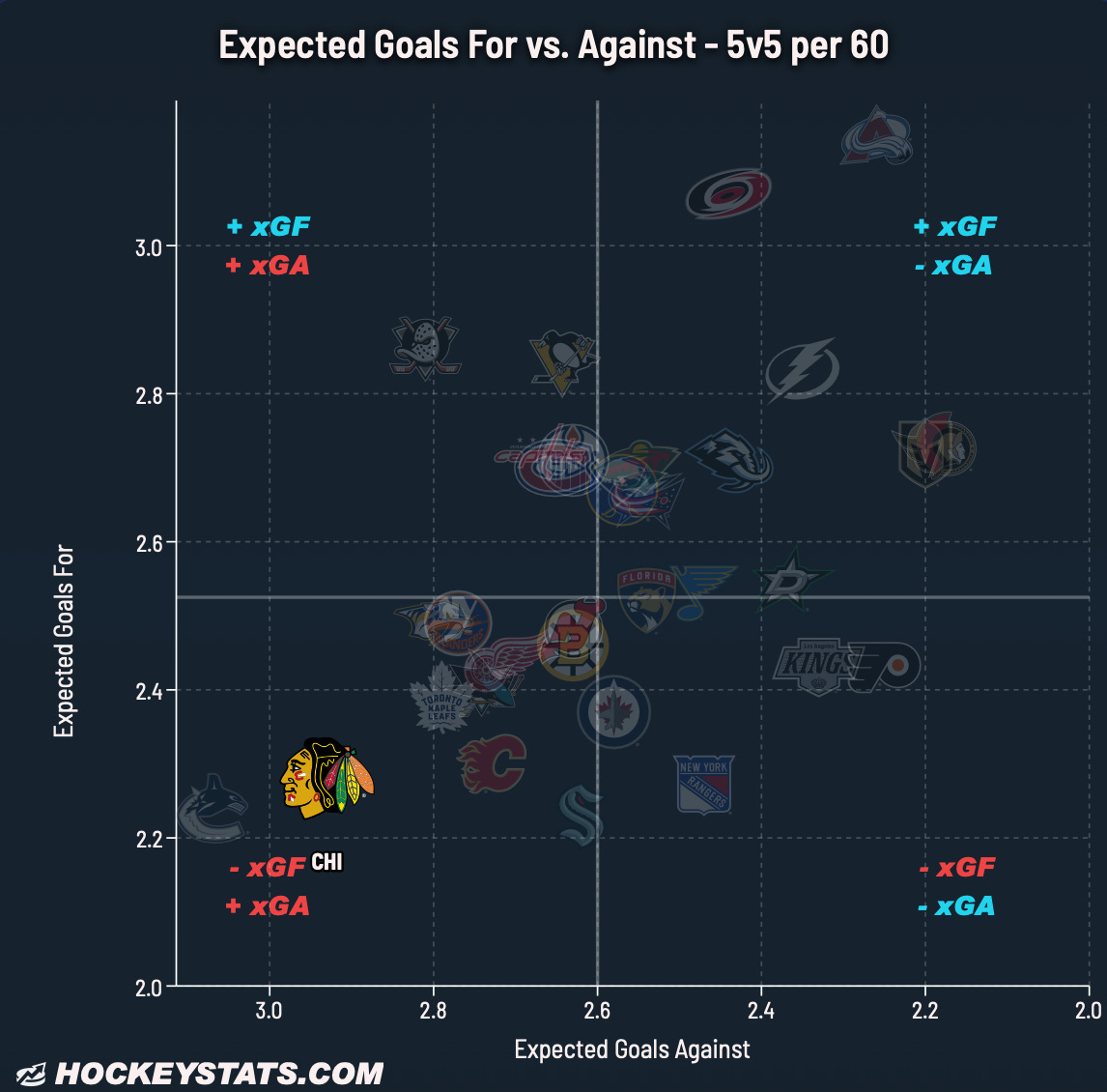
The Hawks were one of the worst teams in expected goals share and there really isn’t anything worth gleaning from those numbers. They were towards the bottom in nearly every category. Most of that has to do with the youthfulness of this roster. Some of it has to do with coaching decisions from Jeff Blashill and his staff (more-so on the forecheck). But while players like Kane can help the Hawks improve in their 29th overall power play (he’s in the 93rd percentile in JFresh’s WAR), it’s the defense that will impact Chicago’s numbers this season.
The Blueline
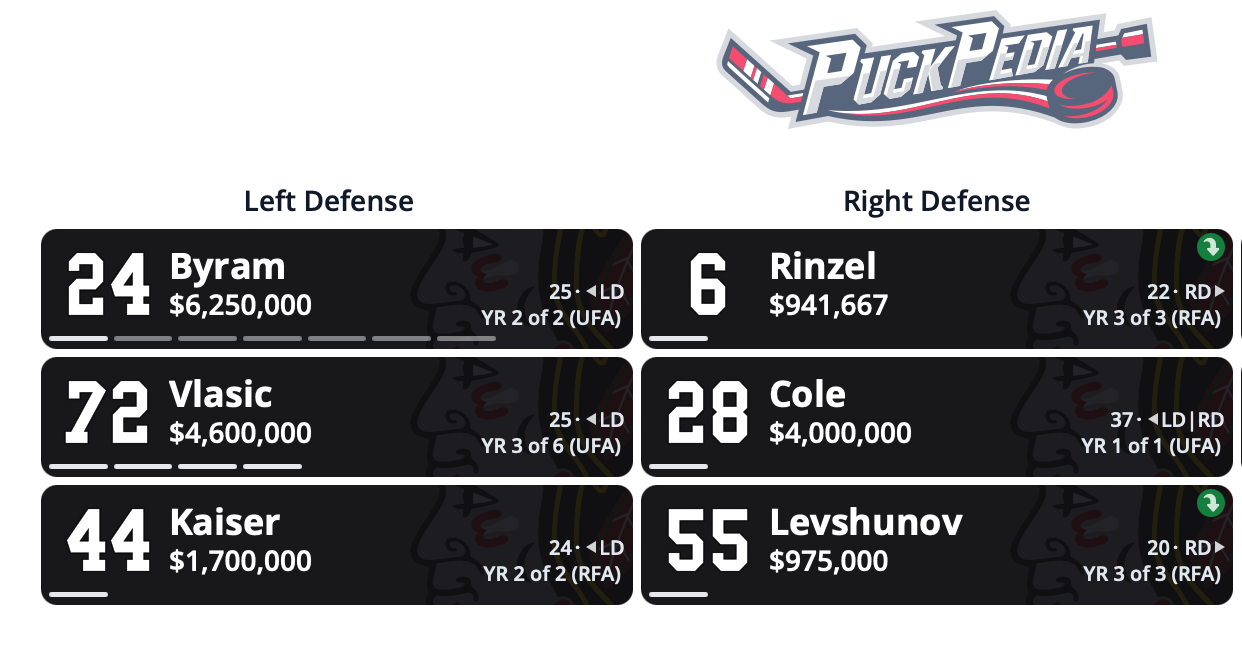
In: Bowen Byram, Ian Cole
Out: Louis Crevier, Matt Grzelcyk
Scratched: Kevin Korchinski
Where fans and beat writers (and myself) clamored for a winger for Bedard, Davidson saw a need for a No. 1 defenseman. Bowen Byram helps the Blackhawks blue line in terms of moving the puck. In a vacuum, Byram helps this team out. The massive contract signing (for an unproven No. 1 defenseman) is beyond the scope of this article. But there are a lot of questions concerning Bowen’s ability to actually play in that role. A No. 1 defenseman must be more than an offense savant. They need to be smart defenders as well.
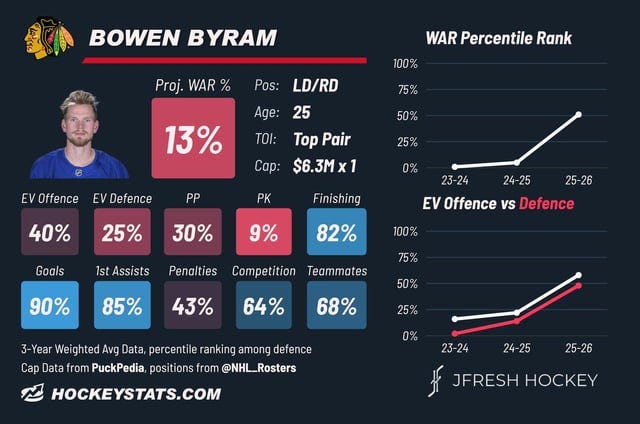
Sam Rinzel will likely play with Byram (and we don’t know that for sure, yet). Last season, Rinzel displayed solid moments of smart playmaking on offense but struggled in his own end a lot of the times. As young defensemen are wont to do. Byram will have to clean up a lot of that. A responsibility doubled should Artyom Levshunov get a look here (and he should).
Of the current defenders, Alex Vlasic may fare the best in his own end. His numbers last year were likely impacted by Louis Crevier (Vlasic’s 39.90 xG% at 5v5 was second worst among Blackhawk defenders). Blashill might pair him up with Ian Cole, although it’s best to pair Vlasic with one of Levshunov or Rinzel. And why not, considering they will be playing together for the foreseeable future? Vlasic could make an excellent safety as he isn’t a puck mover (although he displayed a tendency to carry the mail a few times last season, but that’s not his role).
Then there’s the bottom pair. Wyatt Kaiser makes sense here. Last season he showed a lot of growth and his comfort on ice was visible as he continued to make smart plays in the offensive zone and improved over the course of the season on the defensive zone. His 42.61 xG% at 5v5 was third best on the team for defensemen with over 20 games. Kaiser will likely partner Levshunov or Kevin Korchinski. Ideally, Cole gets bumped down here to give Levshunov his much needed minutes.
Levshunov really does deserve an article all of his own. There’s a lot of questions which were only heightened when Davidson acquired Byram. Levshunov has had a turbulent few years playing at a variety of different levels. The tools are nice, but his hockey IQ is concerning.
In the scratched section is Kevin Korchinski. It’s a big season for him. Korchinski will have to prove that he’s the defenseman that Davidson thought he was when he was drafted. He’s an excellent skater who can make a solid first pass, but his woes in the DZ have made the organization doubtful of his impact (particularly, his physicality or lack thereof). His development path hasn’t been ideal and he’s still young. Does Korchinski improve to make his case? Or does he get traded down the road?
As Sam Fels pointed out in his article, the numbers suggest there’s still a lot to like about Korchinski. Although attackers had the easiest time creating entries against Korchinski, he also had the highest denial rate according to All Three Zones data (in a very limited sample size). Something worth mentioning amidst his recent two-year extension.
The biggest question surrounding the Hawks blue line is how big of a step the kids take forward. Then there’s the question of what Blashill will have them run in their own end.
Blashill’s system grew more conservative as the season wore on last year. By the end of the season, the Hawks were running a man-on-man defense that seemed to overwhelm the younger players on the team. There’s a reason why pure man-on-man isn’t run on most teams. But if it works out, it helps facilitate “position-less hockey.” If one of Byram, Rinzel, or Levshunov get the puck high in their own end, the opposition could have a problem on their hands.
Again, another topic worthy of its own article.
Either way, there will be growing pains in the Hawks own end. Growing pains that only so much goaltending can cover up.
Goaltending
If Spencer Knight continues to play solid in net, we’ll likely see some goalie wins again. Defensive breakdowns from the Hawks will test Knight.
Knight finished at 14th overall for Money Puck’s goals saved above average metric (10.9). He topped the list early on a few times last season, too.
With 54 games played, Knight had a solid workload under his belt. Enough to give comfort that the Hawks have a starting goaltender. He posted a .902 save percentage (SV%) and looked solid most nights.
Arvid Soderblom will probably play his last season as Knight’s backup. If Soderblom looks good, he could be someone that’s moved at the deadline. Of course, a lot of this depends on Drew Commesso’s development.
Commesso played 37 games in Rockford with a .901 SV% last season, which is slightly lower than the AHL’s inflated average (which hovers around .905). But having been in Rockford since 2023 (with a couple of NHL appearances), Commesso will probably be getting more looks as Knights backup this season.
Predictions
The Blackhawks are projected to finished around 31st again. Hockey Stats has the Hawks finishing with 78 points and 14th in the West. Looking at the lineup, I find it hard to think otherwise.
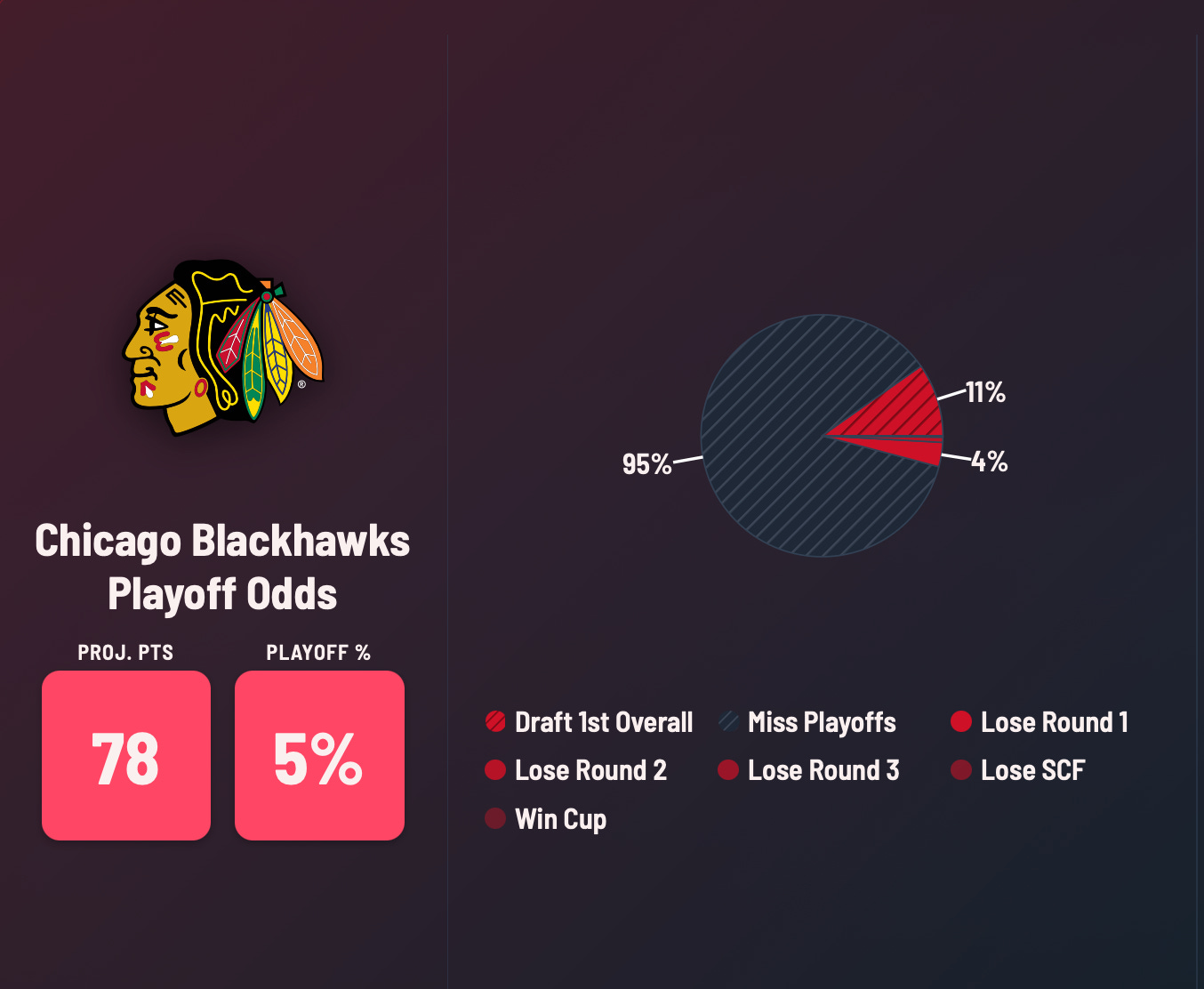
There’s going to be a lot of defensive zone mistakes that test Knight or concede goals. I also have a lot of questions about the Blackhawks’ offense. Both lead me to be less optimistic than some Hawks fans—some who are very hopeful for a wild card spot.
I think this team finishes in either 30th or 29th. There’s going to be early season success with both Kane and when Bedard returns. But defensive zone breakdowns will continue to manifest themselves as the season wears on and a middle stretch tests this team. Much like last season.
Best case scenario, Kantserov is who we think he is, Bedard has a phenomenal season upon his returnn, Patrick Kane plays excellent, and all the young forwards take a step forward. On the blue line, we’re looking for Bowen to be an excellent puck moving defensemen and all of the young kids to take a step forward.
Feels like a lot to ask, doesn’t it?
All players listed “out” are those moved in the offseason.