


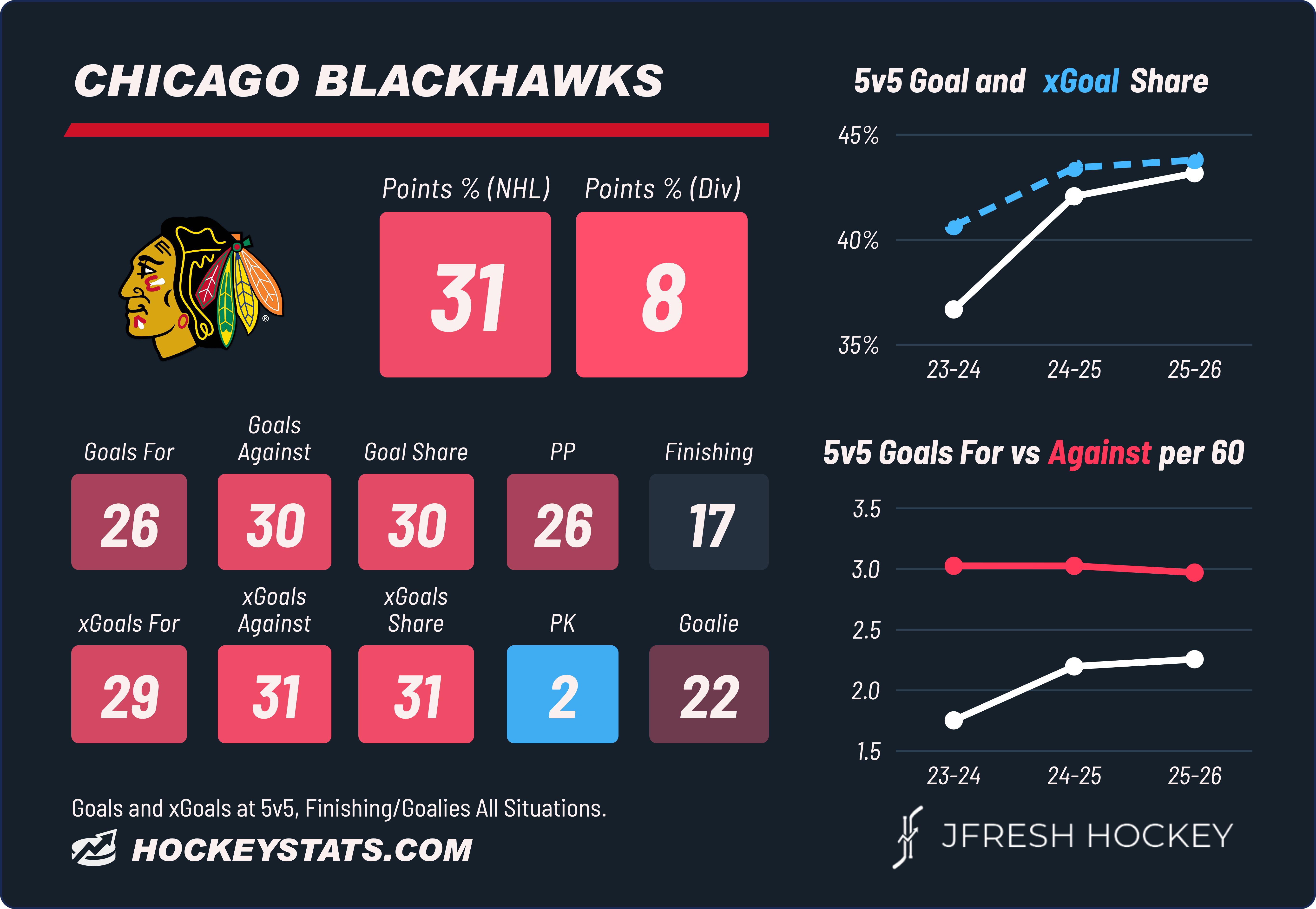
The Chicago Blackhawks were one of the worst defensive teams in the 2025-26 season. They ranked 31st in expected goals against and a slightly better 30th overall in actual 5v5 goals against—likely because of stellar goaltending from Spencer Knight and his 14th overall goals saved above expected. And it doesn’t take a genius to quickly diagnose the problem: the Blackhawks used a man-on-man defense with inexperienced players.
Looking at JFresh’s metrics, Sam Rinzel ranked in the 25th percentile in even strength defense. Artyom Levshunov was in the first percentile, as was Kevin Korchinski but he only played thirteen games. Wyatt Kaiser was in the 47th percentile. Alex Vlasic led the Hawks’ young defenders by finishing in the 72nd percentile. Even though Louis Crevier is no longer a Blackhawk, he ranked in the 20th percentile. Bowen Byram and his 25th percentile ranking joined the backend over the summer.
This shouldn’t come as a surprise. Rinzel, Levshunov, and Korchinski all lean towards offense. Rinzel started the season looking overwhelmed in his own end but slowly improved as the season went on. Levshunov looked lost, period. And Korchinski struggled with the physicality aspect of defending.
Kaiser does deserve recognition for his improvements as the season went on. Although he tops out as a third pairing defenseman, I thought he was the best defender to close out the season.
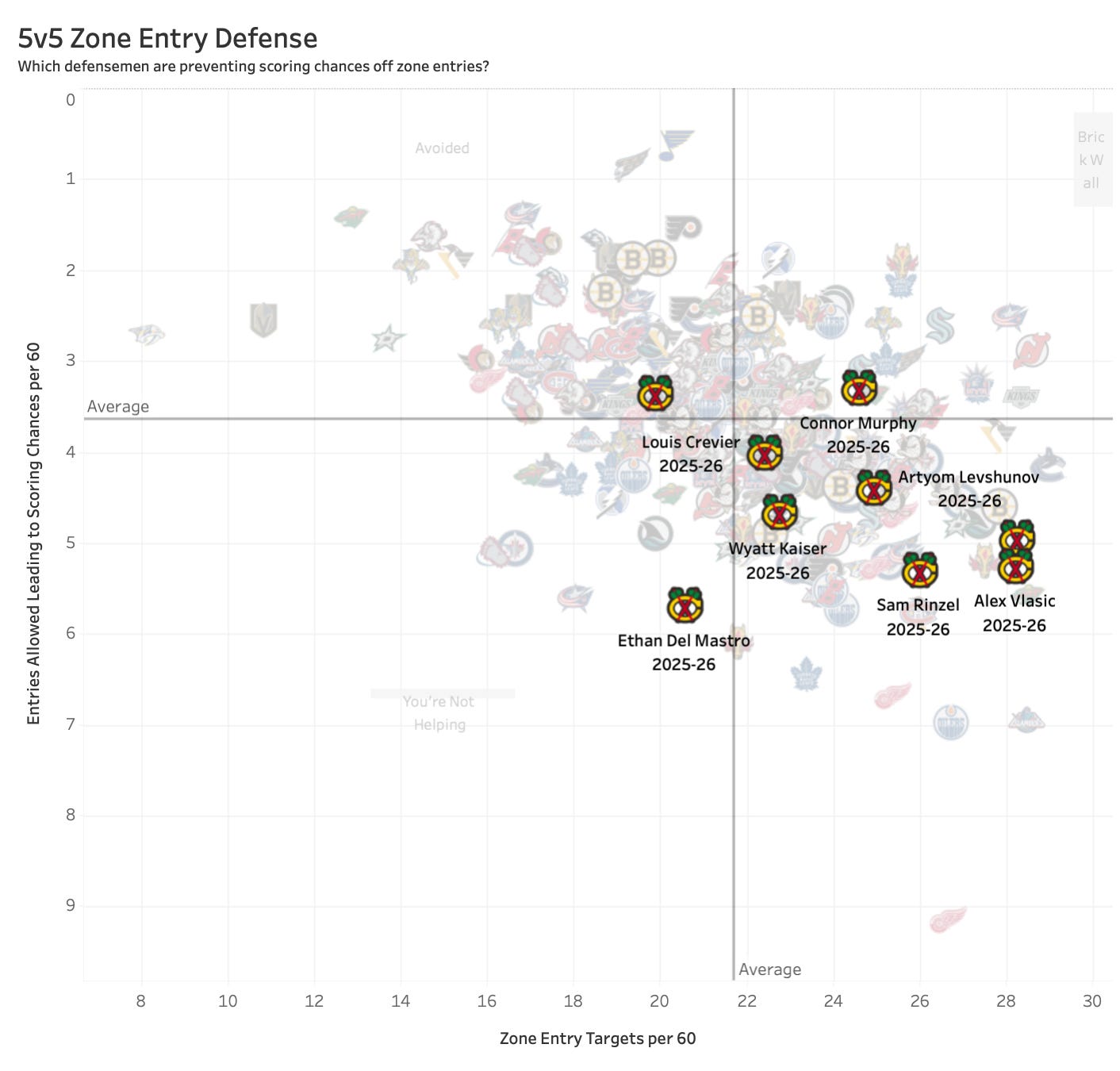
Last season, this core struggled with 5v5 zone entry defense. Vlasic, Korchinski, Ethan Del Mastro, and Sam Rinzel allowed some of the most entries leading to scoring chances per 60 in the league.
Here’s a clip that came during one Chicago’s most egregious games:

Granted, context matters. This was at the very end of a spanking handed to the Hawks in the form of a playoff bound Buffalo Sabres team. But many goals against were caused by a similar mistakes stemming from poor positioning in the offensive zone that left a defender fending off a 2-on-1, or a poor timed neutral zone pinch where a strong side defenseman pressured without support.
Another reason for their high entries against metrics is that Blashill had the Hawks shell up when protecting a lead. Gaps were generally looser if the Blackhawks were up even by a goal. This led to prolonged time in their defensive zone, which led to exhaustion, and compounded into mistakes. Keep in mind, the Hawks were running a man-on-man defense.
According to Natural Stat Trick, at 5v5, the Blackhawks ranked 31st in shots on goal against per 60, 26th in shot attempts per 60, 32nd in scoring chances allowed per 60, and 32nd in high danger chances against per 60.
Here’s another poor example of a defensive zone entry:
It’s not fair to pin the Blackhawks defensive shortcomings squarely on the shoulders of the young defensemen. The forwards deserve their fair share of the blame, as well. Forwards were often caught puck watching and leaving the slot open, skating past the net front on a back check, or looking generally uninterested in playing defense.
What can Blashill do?
Playing zone defense will limit mistakes but has the real danger of further keeping the Hawks stuck in their own end. Playing man-on-man (when it’s successful) is designed to kill the play and limit time spent in the defensive zone. In theory, man-on-man defense should facilitate offensive defensemen attacking on the rush. With skaters like Byram, Rinzel, and Levshunov (Korchinski too if he stays), they should be able to join the rush on a defensive zone turnover.
But they need to eliminate poor defensive zone entries in the first place.
Blashill will likely keep his defensive structure in place. But other than the addition of Ian Cole (a bottom four veteran), the Hawks don’t have any real strong defenders. Vlasic qualifies to an extent. Levshunov is a liability, even if the focus should be on his offense. Bowen Byram is supposed to be excellent in offense, but as the number one defenseman he needs to be excellent on the back end too. And that’s unproven.
And that’s not even scratching the surface on the forwards, most of them aren’t known for being true two-way forwards. Despite a poor offensive season, Teuvo Teravainen did finish in the 85th percentile in even strength defensive metrics. But the forward core got younger this season.
Even if the Hawks take a step forward, we can expect a lot of growing pains on defense this season. I wouldn’t be surprised if it looked similar to the Anaheim Ducks last season, who were atrocious on defending the rush due to aggressive pinching in the offensive zone without forward support.
It might get a tad messy.