The Chicago Blackhawks 2026-27 season hinges on how this team plays in the absence of Connor Bedard and how Bedard performs upon his return. And what exactly is being hinged? It’s certainly not a playoff run, but not finishing in the bottom three would be nice (although nearly every model projects the Hawks to finish as such). The defense won’t be expected to carry the Blackhawks out of the bottom. On the other side of the ice, where the Hawks try to score goals, there are a lot of unknowns (Kantserov) and holes (a general lack of offense). If the Blackhawks want to crawl out of the basement, they’ll have to generate meaningful scoring chances and improve on the rush.
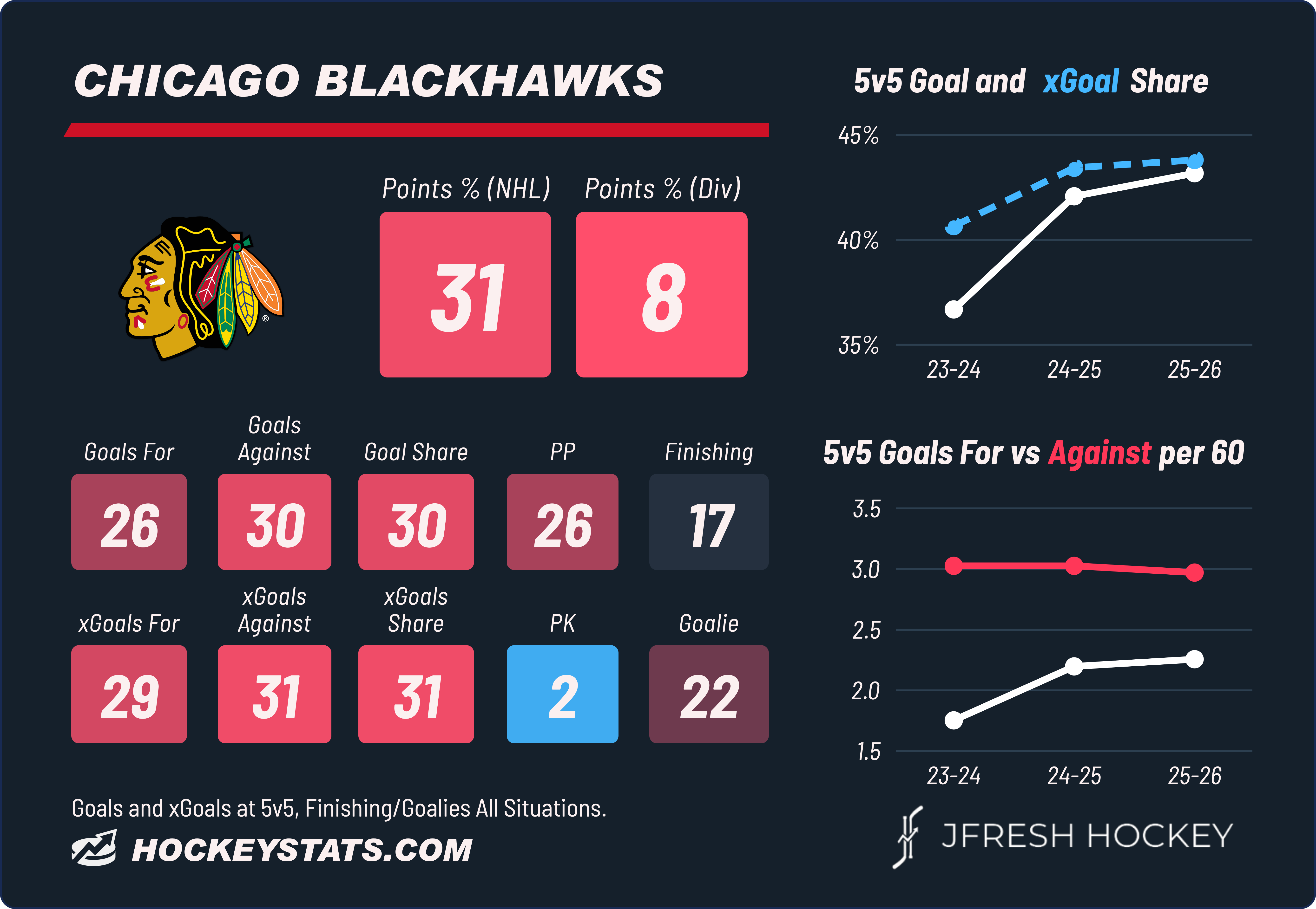
Chicago ranked 26th in 5v5 goals and 29th in expected goals last season. Beyond Connor Bedard, they didn’t have anyone up the entire season that made a huge impact on offense. Frank Nazar (arguably their second-best forward until Anton Frondell arrived) had a very quiet middle where he scored ten points in 34 games. The Hawks offense rarely generated anything off the cycle, their forecheck was passive, and most of the lineup chipped the puck into the zone rather than carry. But there was one method of attack that could have been a lot more intriguing: the rush.
With the amount of young players with speed on this roster, you would expect there to be at least a handful of players with high-scoring chances off the rush. Connor Bedard, Oliver Moore, Frank Nazar, and Nick Lardis for the forwards. This wasn’t the case. Only one player stood out in shots off the rush per 60.
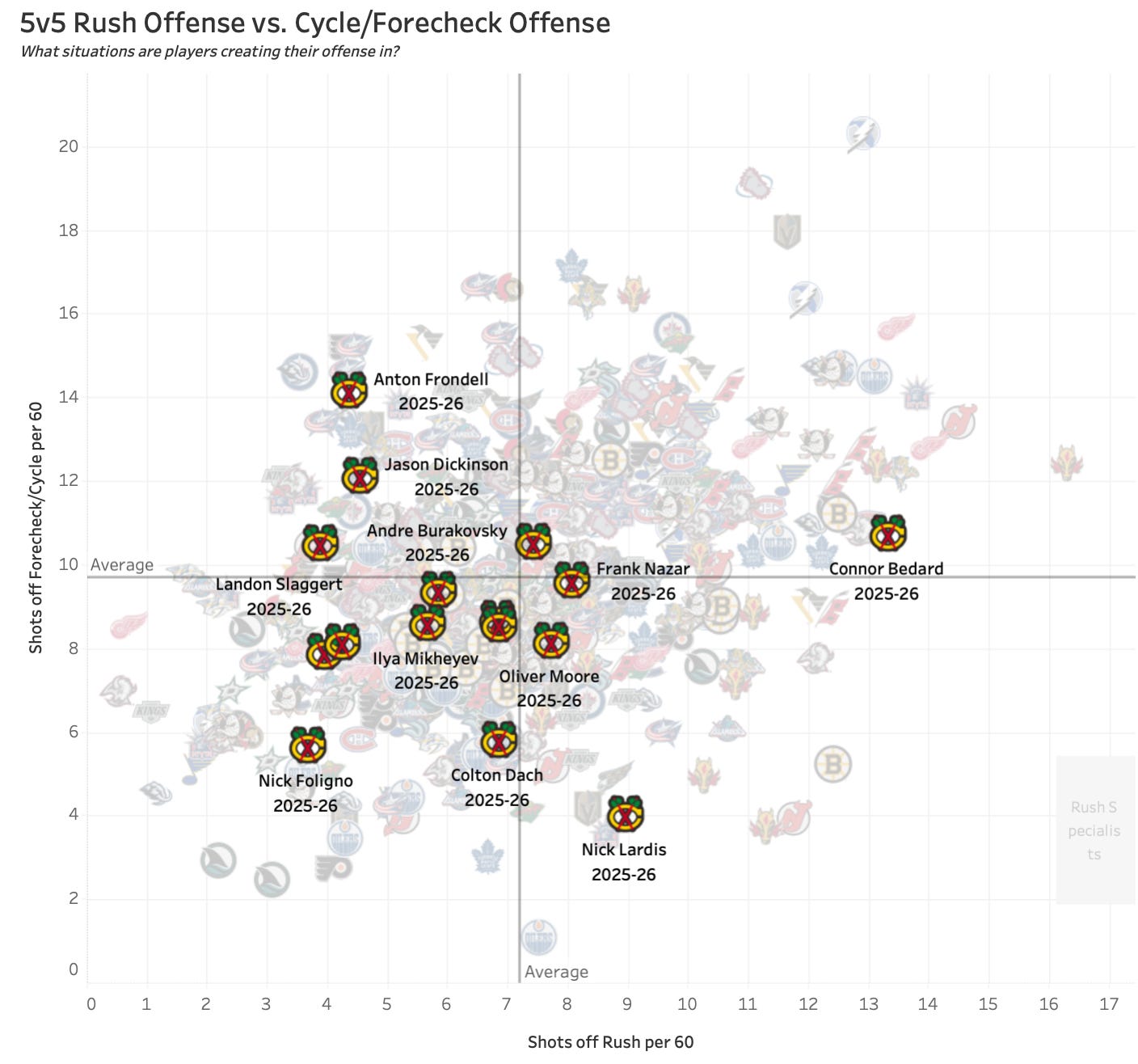
Connor Bedard led the Hawks in shots off the rush per 60 with 13.33. The next highest was Nick Lardis with 8.96.
This comes as no surprise, considering Bedard’s style. He likes to play high in the defensive zone to capitalize on an outlet pass and initiate the rush. It’s just that there weren't any other players who came close. Sure, Moore was in his first full-ish NHL season, Lardis too, and we’ve already mentioned Nazar’s quiet middle. But I expected more offense from some of the younger players. Maybe not to Bedard’s level of production, but certainly a little higher than where Nazar is plotted on the above chart.
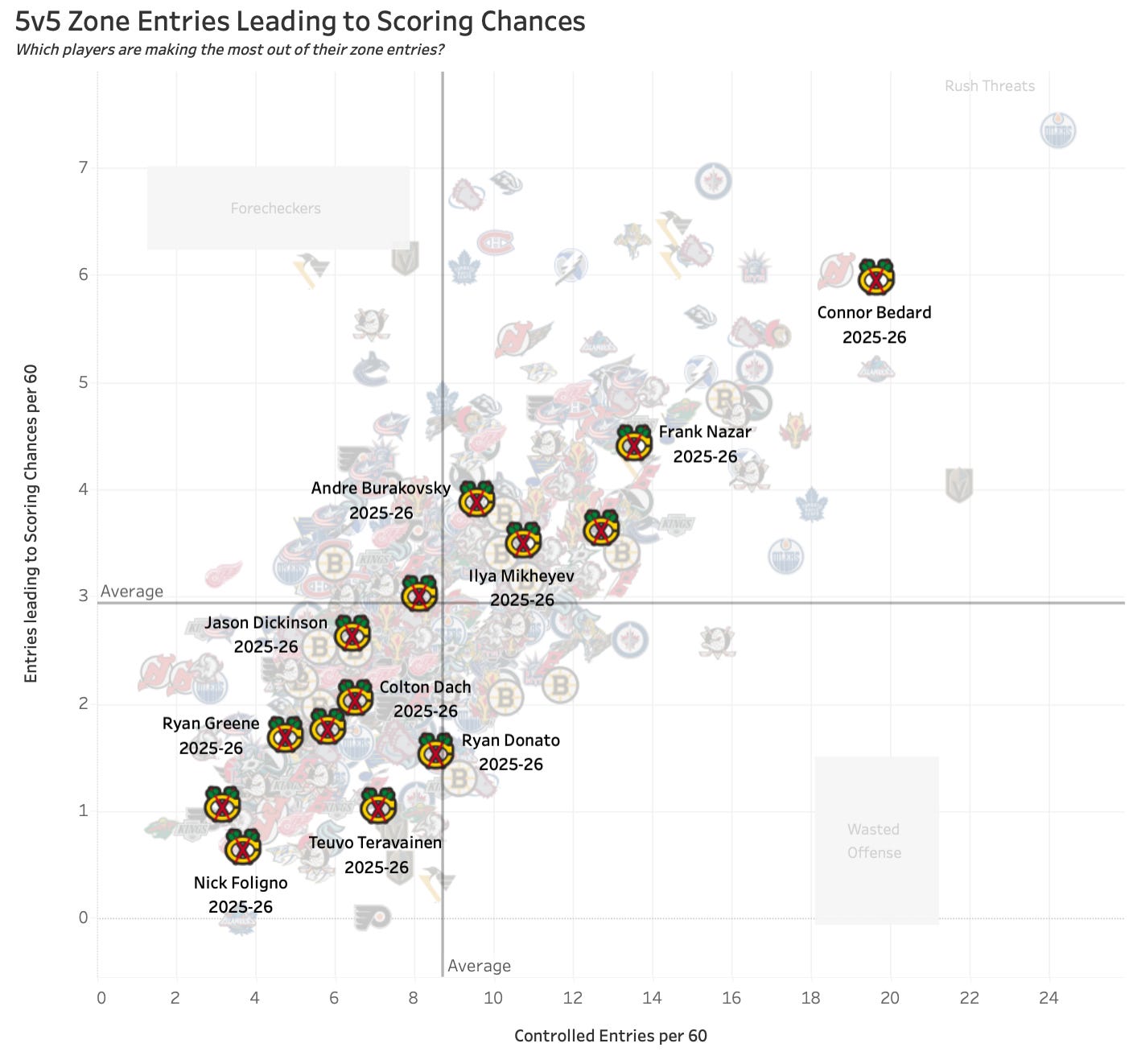
Getting into the offensive zone was its own issue. Bedard led the Hawks in both controlled entries per 60 and entries leading to scoring chances per 60. In fact, he was among the league leaders. One wonders what could have happened if Bedard had a competent linemate. Frank Nazar was next on the team, and he was in the 90th percentile in controlled entries according to Hockey Stats’ model. Both players will benefit from competent linemates this season: a longer look with Anton Frondell, a developing Roman Kantserov, and an older but still impactful Patrick Kane.
Patrick Kane was in the 96th percentile for rush shot assists and the 100th percentile for rush offense. While he might be better suited to play with Nazar than Bedard (because both players want the puck), he’ll be a much better fit than what either player had to work with last season. And an aside, I’m not saying that Kane was the best fit for this need. Bedard still needs a winger. However, I do think that Kane will have a much better impact than what some of the naysayers believe.
In the zone, the Hawks didn’t do a whole lot. They generated 23.03 5v5 scoring chances per 60 (ranked 31st) and 9.24 high danger scoring chances per 60 at 5v5 (also 31st). When Chicago had the rare offensive zone possession, they didn’t try to cycle and often wasted opportunities by trying to find perfect seam passes. But their motion plays involving their defensemen had a lot of interesting looks, even if they lacked finish.
Across the d-pairs there’s offensive minded defensemen everywhere. Bowen Byram on the top. Sam Rinzel and Artyom Levshunov and their developing adventures. Kevin Korchinski, should he make his mark (and I already said my piece on what I think of Korchinski). Any of those players can create offense; it’s just a matter of the high forward covering a pinch to prevent odd-man rushes.
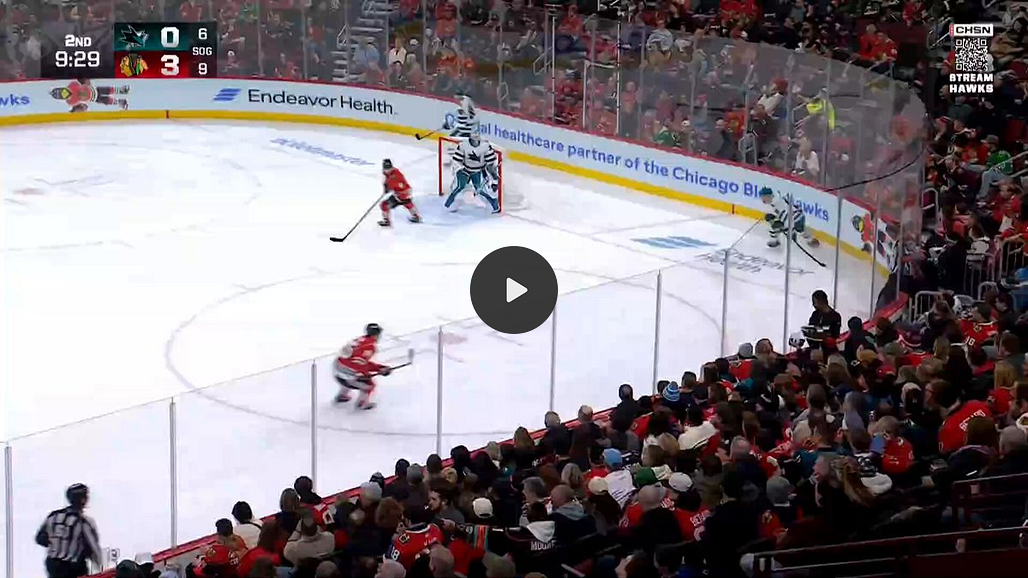
In the clip below, watch Andre Burakovsky (CHI 28) cover the left point as Levshunov (CHI 55) motions.

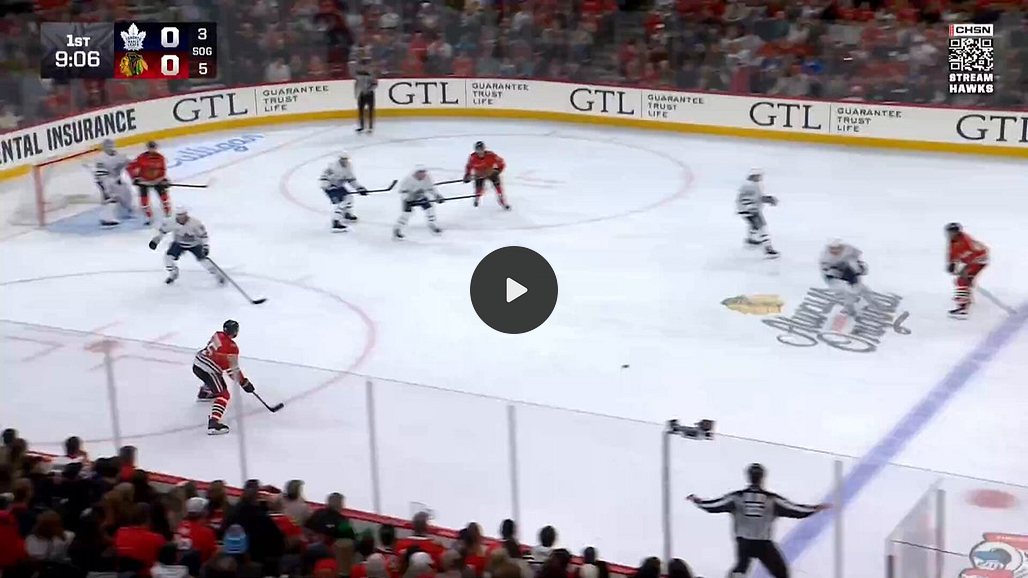
Where the Hawks’ offensive pressure lacked bite, their forecheck didn’t do much of anything. To start the season, Blashill had the Hawks use a more aggressive 2-1-2 forecheck. When the Hawks got possession, the weak-side D was encouraged to pinch. However, turnovers led to odd-man rushes against, and Blashill resorted to a more conservative 1-2-2 forecheck.
With the 1-2-2, the Hawks dumped or chipped the puck in. This is a horrible way to generate offense. Most goals and scoring chances are created from controlled entries. Chicago won’t be built to be a forechecking menace like Carolina or Florida, but they have a player who could be very effective on the forecheck: Anton Frondell. Vinh Cao wrote an excellent piece on Frondell that I highly recommend checking out.

Even with the limited look at Frondell, there’s a lot to like about what he brings to the Hawks’ offense. His ability to make himself available as an option on offensive zone entries should help. Whether that’s driving his own line as a center or playing on the wing. But he’s only played 12 games that came at the end of the NHL season. Roman Kantserov is even more unknown until we see how he looks in the NHL. Nick Lardis could be someone who helps the top-six, but we also just don’t know yet.
Until Bedard returns, a lot of those younger players are going to have to prove themselves early on—Nazar included. Patrick Kane will help to a certain extent, but he’s not someone to hang the entire offense on. This leads me to think that Blashill will keep things conservative to start the season and run the same 1-2-2 forecheck. What this team needs is to let the blue line run some of their adventures, even if it costs them scoring chances against. Utilize the youth’s speed on the rush, nail offensive zone entries, and the recipe for fun hockey is there if you squint hard enough.